This blog was originally published in VP of Climate and Carbon Brandy Lellou’s LinkedIn column, The Integrity Equation.
Every carbon project has two versions: the one that exists on paper and the one that exists in the field.
High-integrity projects are not the ones where those versions are identical. They are the ones that continually learn, adapt, and close the gap between them.
Carbon projects are simultaneously financial instruments, biological systems, community development programs, and operational machines. Nowhere is that complexity more visible than in the field.
The following are a few examples of this from my April field visit to Trees for the Future’s Lake Victoria Watershed Agroforestry Carbon Project in Kenya.
Measuring Carbon
One of the goals of the visit was to review our 2025 monitoring data (which showed high variability between farms) and continue refining how we would stratify and measure carbon across thousands of smallholder farms moving forward.
On paper, TREES’ carbon monitoring data indicated a large variation in measurable tree growth, with many farms registering very low carbon values. If we submitted a monitoring report to Verra, this would have led to a large uncertainty deduction. Instead, we chose to further evaluate the source of the challenges and determine a re-stratification strategy.
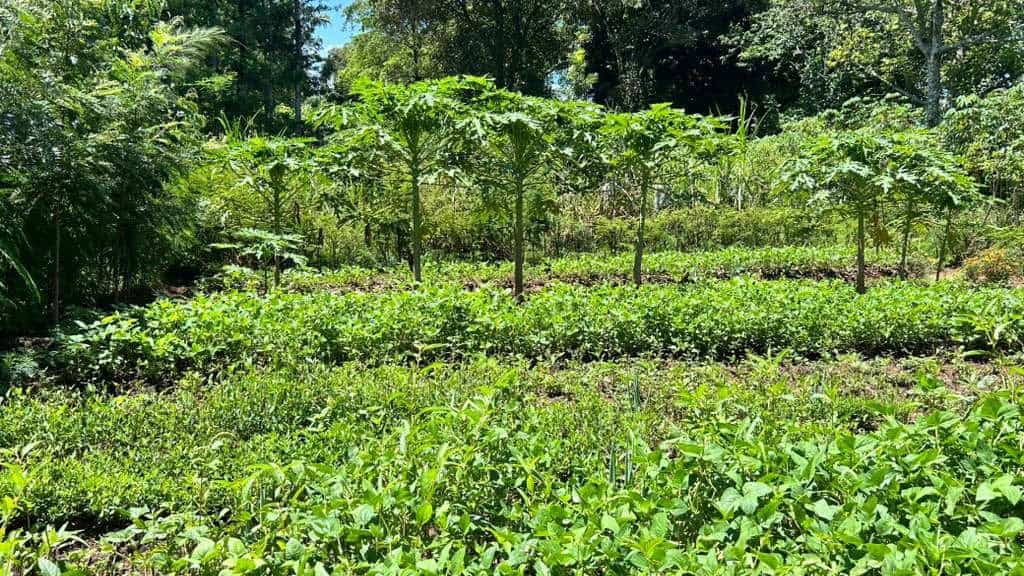
In the field, we observed that most farms (with low carbon values on paper) had trees that were present and clearly thriving. The trees simply had not yet reached the minimum 5 cm DBH threshold required for measurement within the project’s carbon accounting system.
Farmers had invested years into establishing and managing these trees, yet much of that growth remained effectively invisible in carbon accounting.
What We Are Learning – The science behind carbon storage in trees is relatively straightforward. The operational reality is not. This highlights a recurring challenge: measurable carbon accumulation does not always align with investment timelines or crediting schedules.
As we reviewed the monitoring data and visited farms, I was struck by how consequential a relatively short period of growth can be. Another rainy season or two could materially change measurable carbon volumes across many farms.
While the market increasingly distinguishes between pre-2030 and post-2030 credits, trees do not grow according to calendar dates. They grow according to rainfall, soils, management, and time. Perhaps that is one of the central challenges of nature-based carbon development: biological systems move at their own pace, while markets and investors often operate within fixed timelines. Much of the work lies in responsibly bridging those two realities.
As we reviewed the monitoring data and visited farms, I was struck by how consequential a relatively short period of growth can be. Another rainy season or two could materially change measurable carbon volumes across many farms.
While the market increasingly distinguishes between pre-2030 and post-2030 credits, trees do not grow according to calendar dates. They grow according to rainfall, soils, management, and time. Perhaps that is one of the central challenges of nature-based carbon development: biological systems move at their own pace, while markets and investors often operate within fixed timelines. Much of the work lies in responsibly bridging those two realities.
Standardization vs. Farmer Reality
One of the more interesting aspects of visiting farms is seeing how differently farmers apply the same agroforestry principles. Land size, soils, household priorities, labor availability, and market opportunities all shape implementation. Over time, each farm becomes a reflection of the decisions made by the family managing it.
On paper, carbon projects are expected to have consistency and uniformity in species selection, spacing, and management practices to simplify quantification and reduce uncertainty. TREES has a detailed and prescriptive agroforestry design that serves as the foundation for implementation.
In the field, I find every farm is significantly different. And honestly, this is one of the strengths of the program. The flexibility for farmers to adapt agroforestry principles to their own circumstances is part of what gives these systems strong permanence potential. They are not monocultures imposed externally; they are living systems shaped by the farmers managing them.
But this variability also creates one of the biggest challenges in smallholder carbon development: how do you fairly and accurately measure carbon across thousands of highly individualized farms?
What We Are Learning – The future of smallholder carbon development may depend less on maximizing standardization and more on improving our ability to understand and measure variability. As we explore new terrestrial monitoring systems, LiDAR, and high-resolution imagery, I am encouraged by the potential of these evolving technologies to measure the variability that is inherent in natural systems but complicated in carbon accounting.
Carbon Value vs. Farmer Value
What matters to the market in New York differs from what matters to the market in downtown Homa Bay, and this illustrates an important tension within many nature-based carbon projects.
On paper, project activities are often prioritized based on a mix of trees that quickly achieve measurable carbon benefits and trees that have long-term sequestration potential.
In the field, we visited a farmer who had developed a highly productive agroforestry system with many large agroforestry and timber trees and multiple integrated income streams. He explained that one of the most reliable income sources was the sale of Calliandra leaves, harvested from hedgerows and sold as fodder to a nearby fish farm.
From a carbon accounting perspective, these hedgerows are difficult to measure and unlikely to represent a significant long-term carbon sink. As a result, they are not currently included within the project’s carbon accounting approach.
Yet from the farmer’s perspective, they are enormously valuable.
The hedgerows generate reliable supplemental income, support broader farm productivity, and contribute to the overall resilience of the system.
What We Are Learning – Some of the components that matter most to farmers and long-term system durability may not contribute to measurable carbon outcomes. At the same time, those components may play an essential role in adoption, permanence, and livelihood resilience.
Building Integrity Beyond the PDD
On paper, our VCS/CCB project design document (PDD) established the structure through which the project was validated and expected to operate. Five sections, 250 pages, 84 supporting documents. Detailed, neat, and compelling.
In the field, there were multiple overlapping, competing priorities throughout the week. One team was conducting Carbon 101 trainings with staff, bridging the gap between theory and field implementation. Concurrently, project officers were tracking rainy season outplanting, and program managers were meeting with county commissioners and local chiefs to improve land-tenure documentation processes.
What We Are Learning – Most nature-based carbon developers are learning while doing. None of this work appears prominently in a registry listing or project design document, yet it is often what determines whether a project succeeds.
The methodologies and standards that define project requirements, the investment structures that support them, and the Core Carbon Principles that guide them are increasingly sophisticated. But field implementation remains deeply complex and dependent on local ecological conditions, farmer decisions, and practical realities that rarely fit neatly into standardized models.
The PDD is where a project begins.
Building Integrity is what happens next.
This article was originally published in The Integrity Equation—a bi-weekly newsletter by Brandy Lellou, the Vice President of Carbon & Climate at Trees for the Future leading the development of the Lake Victoria Watershed Agroforestry Carbon Project.
In April 2026, TREES Partner Component Earth signed a $54M deal with Trafigura to enhance and expand the Lake Victoria Watershed Agroforestry Carbon Project. Building from experience and ongoing implementation learnings, The Integrity Equation examines the evolving realities of carbon markets from the perspective of field implementation, farmer participation, measurement systems, and long-term project integrity.